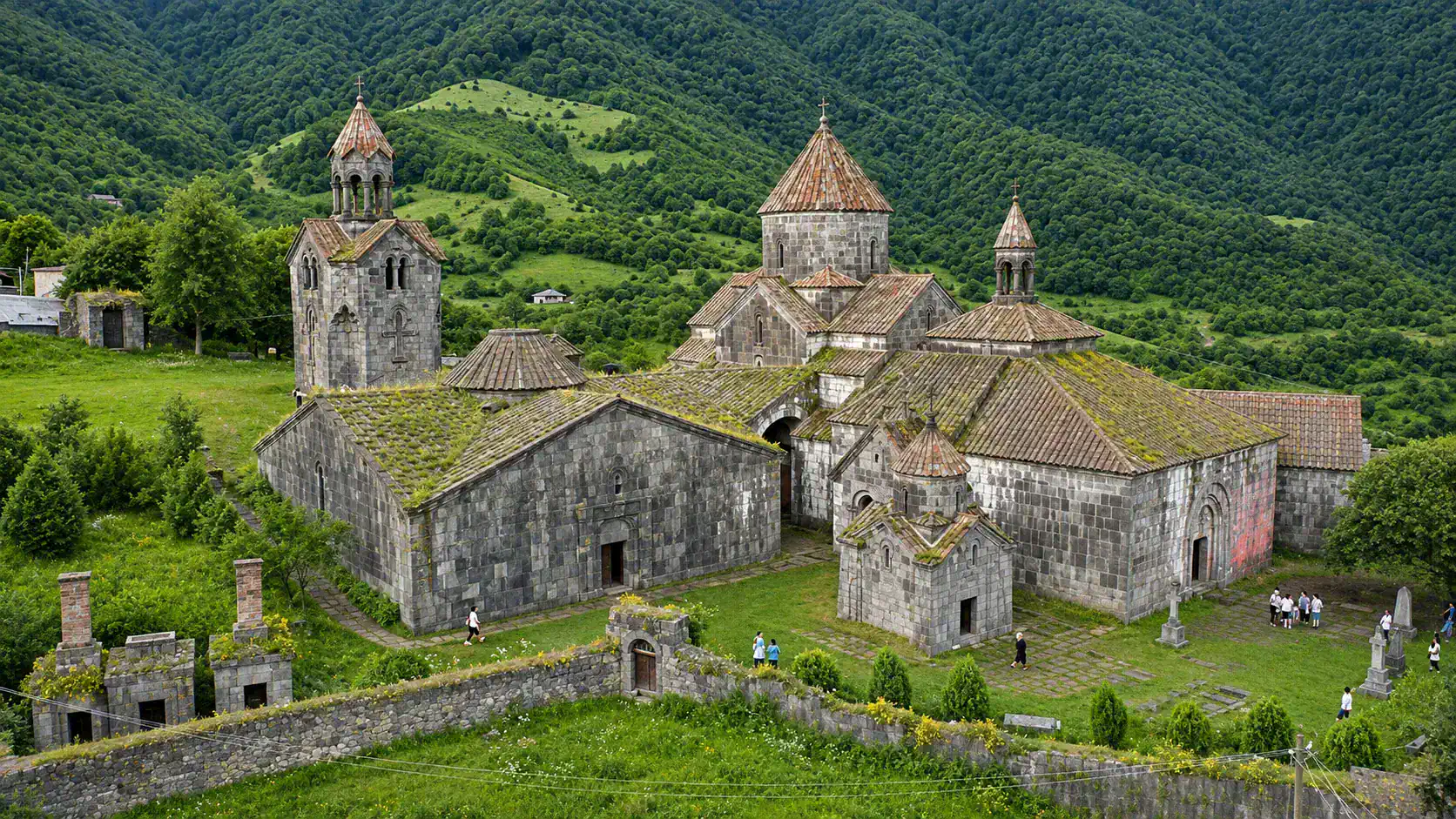
Haghpat is a historic village in the Lori Province of northern Armenia, located approximately 170 km from Yerevan and close to the town of Alaverdi. Situated at an altitude of around 1,000 metres above sea level, the village overlooks the Debed River Gorge and is surrounded by forested mountains, deep valleys and picturesque landscapes. Haghpat is best known for its medieval monastery, but the village itself has a much older history, with evidence of settlement dating back to the 8th–7th centuries BC.
The village became one of the most important spiritual, cultural and educational centres of medieval Armenia. Its development was closely connected to the Bagratuni dynasty and the Kingdom of Lori, also known as the Kingdom of Tashir-Dzoraget. During the 10th–13th centuries, Haghpat flourished as a centre of religious life, scholarship and manuscript production.
The most famous landmark is Haghpat Monastery, also known as Haghpatavank. It was founded in 976 by Queen Khosrovanuysh, the wife of King Ashot III of the Bagratuni dynasty. The monastery was strategically built halfway up a hillside overlooking the Debed River rather than on a mountain peak. Its location offered both protection and a sense of seclusion, while blending naturally into the surrounding landscape.
Over the following centuries, additional buildings were added to the monastery, including the Church of Surb Grigor (St. Gregory), built in 1005, a scriptorium, a refectory, chapels and a three-storey bell tower completed in 1245. The complex also preserves numerous khachkars (Armenian cross-stones), among which the Amenaprkich (All-Savior) Khachkar, dating to 1273, is particularly notable.
Haghpat was not simply a religious site. It was also an important centre of education and scientific activity, where scholars studied philosophy, medicine, rhetoric and theology. Monks and scholars copied manuscripts, developed religious literature and contributed to Armenian intellectual life. Together with nearby Sanahin Monastery, Haghpat became one of the most influential centres of medieval Armenian scholarship.
Throughout its history, the monastery experienced several difficult periods. Around 1130, an earthquake caused significant damage to the complex, and restoration work took approximately 50 years to complete. It also suffered attacks and looting during various invasions. Despite these events, much of its original architecture has survived.
In 1996, Haghpat Monastery, together with Sanahin Monastery, was inscribed on the UNESCO World Heritage List. The two complexes were recognized for their exceptional architectural value and their role as major centres of learning during the Middle Ages.