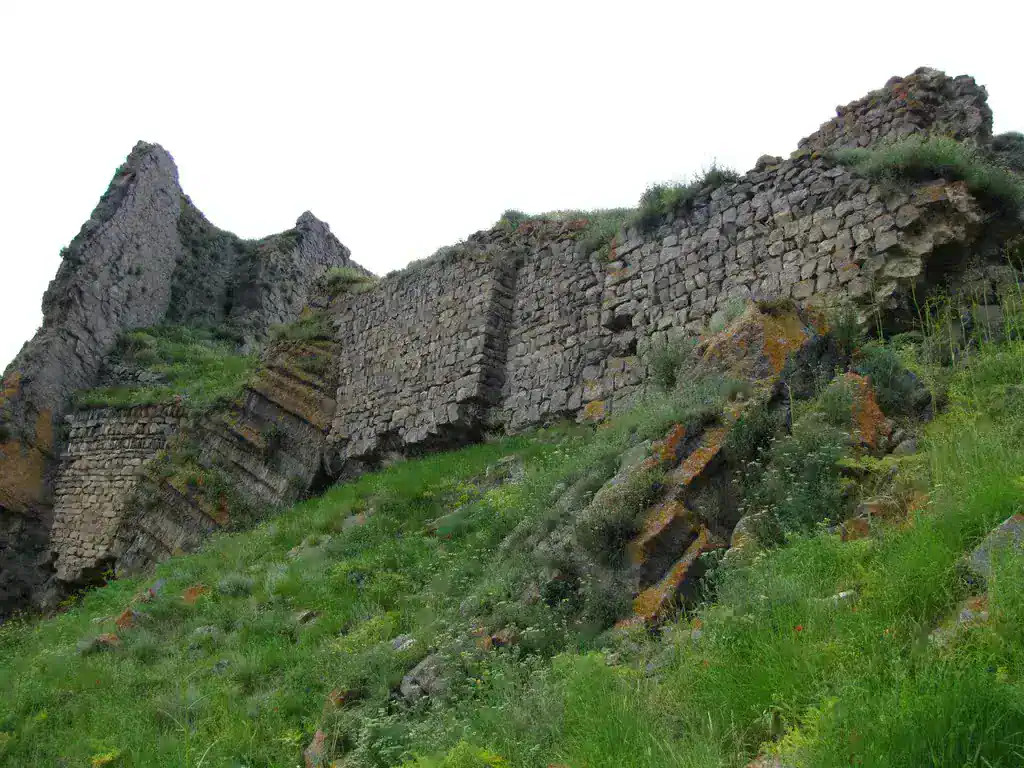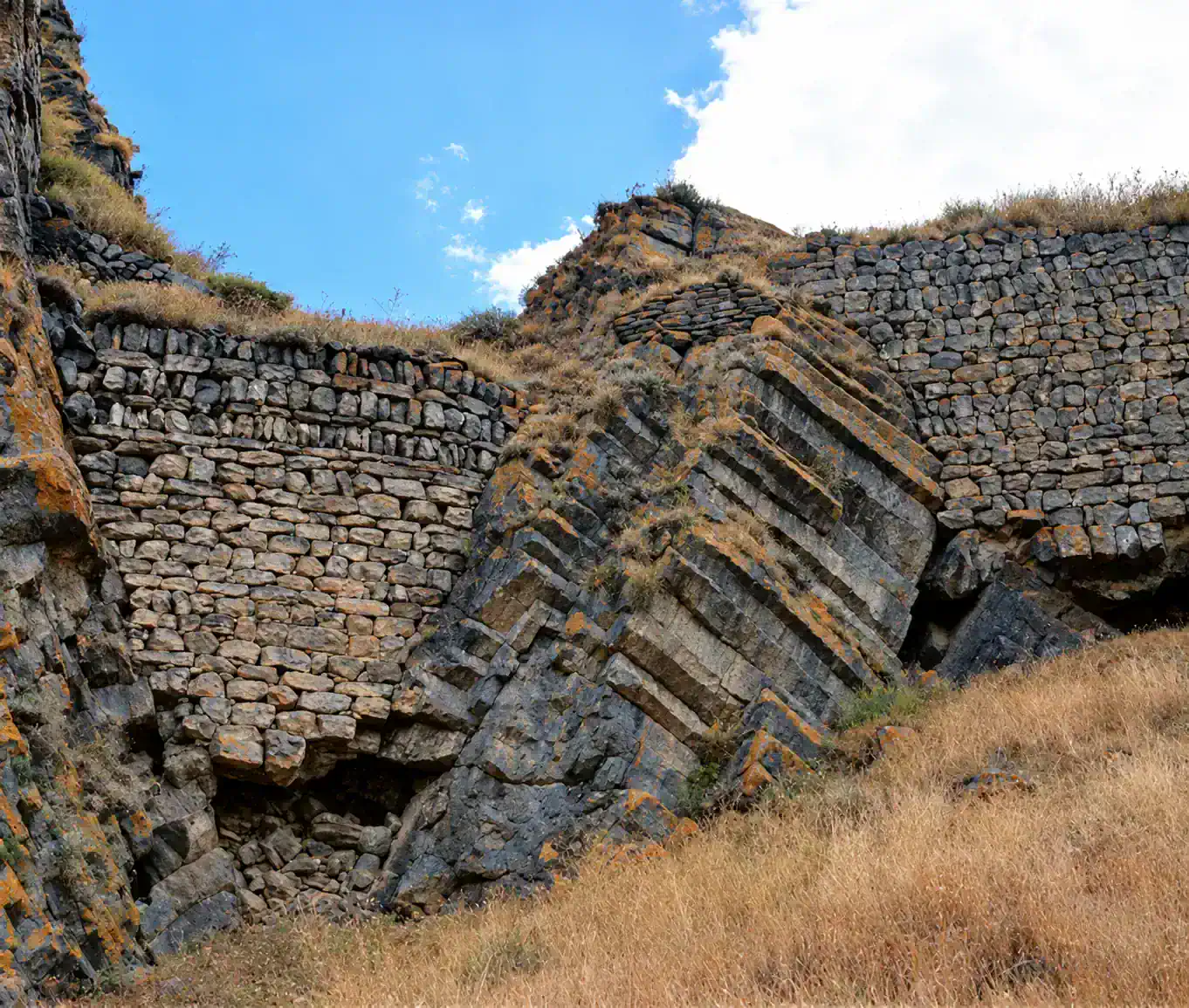
Vorotnaberd is located on a large rocky massif between the mouth of the Loradzor river and the present-day village of Vaghudi. On three sides the fortress's natural rock walls drop steeply down into the Vorotan gorge. The fortress's overall area has the shape of an isosceles triangle. The citadel is located in the elevated southern section. The site chosen for Vorotan fortress was the natural rocky height existing at this point in the Vorotan river valley, from which it was possible to observe large areas and track enemy movements.
A trade road also passed through the Vorotan valley, which entered the district of Tsghuk from the direction of Nakhichevan, passed through the zone controlled by a series of fortresses, and joined the Julfa–Paytakaran international trade road near Karchevan. This position gave the fortress significance not only for military control but also for control of the road.
The average height of the surviving sections of the western outer wall reaches about 5.5 meters. A rectangular niche has survived in the wall, and on the inside, the lower sections of another rectangular structure. In the fortress's southern, citadel section, the remains of numerous rectangular rooms have survived.
In the eastern defensive section, two towers have survived — one round, the other semicircular. They are built of roughly dressed basalt stones with an interlayer of lime mortar. Thanks to its position, the entire river valley was visible from the towers.
In 1219, Ivane Zakaryan, under the leadership of Liparit Orbelian, captured Vorotnaberd. After that, the fortress and the neighboring settlements passed under Liparit's rule, and Vorotnaberd remained for a long time under the authority of the Orbelians. And in 1724, David Bek, having already reached Kapan, besieged Vorotan fortress and achieved victory in combat against the Turks.
In the 10th century, a two-center defensive system, Vorotnaberd–Vorotnavank, formed in Syunik, whose main military center was the fortress, and whose second center was the monastery. According to the information given by Stepanos Orbelian, Vorotnavank was founded by the wife of the reigning prince Smbat — Queen Shahandukht. In 1000, in accordance with Smbat's will, she built the church of Surb Stepanos Nakhavka (the Protomartyr).