Categories
Region
Sundukyan National Academic Theatre play Cultural

Sundukyan National Academic Theatre play

Yerevan

he Gabriel Sundukyan National Academic Theatre, located at 6 Grigor Lusavorich Street in Yerevan's Kentron district, was founded on February 25, 1922, making it the first state theater in Armenia and one of the country's oldest continuously operating theatrical institutions. Named after Gabriel Sundukian, the playwright credited with founding the Armenian school of realistic drama, the theatre received academic status in 1960. Over its history it has staged classical Armenian works alongside international plays by authors such as Chekhov, Brecht, and Camus, and its building features sculptural elements by renowned Armenian artist Ara Harutyunyan. What you can do there: Attend a rotating repertory of dramas, comedies, tragicomedies, and children's productions performed in Armenian; buy tickets at the box office or through local platforms such as tomsarkgh.am and ticket-am.com

National Puppet Theatre show Cultural

National Puppet Theatre show

Yerevan

The Yerevan State Puppet Theatre was founded on June 1, 1935, by Sofia Bejanyan, painter Gevorg Arakelyan, and actors Pavlos Boroyan and Araksia Arabyan; it was renamed after writer Hovhannes Tumanyan in 1938. The theatre closed between 1950 and 1957 before reopening on July 27, 1957, and has operated at its current location on Sayat-Nova Avenue since 1975. Its repertoire spans classic children's fairy tales (both Armenian and international, like Pinocchio and Thumbelina), shadow-puppet productions, and occasional adult/dramatic works — including pieces addressing more serious themes, such as productions referencing the 2020 Artsakh war. What you can do there: watch a puppet or shadow-theatre performance (most weekend shows are family/children's fairy tales, with occasional evening productions for older audiences), typically running multiple showtimes on Saturdays and Sundays.

Live jazz at Malkhas Jazz Club Cultural

Live jazz at Malkhas Jazz Club

Yerevan

Malkhas Jazz Club is widely regarded as the unofficial home of jazz in Armenia, opened in January 2006 by legendary pianist Levon Malkhasyan, who formed Armenia's first jazz trio back in 1963 and had previously built a jazz following at the "Poplavok" café. Armenian jazz itself dates back to 1938, when the country's first state jazz orchestra was founded, and Malkhas Jazz Club carries that tradition forward — an estimated 700 different groups, including international stars, have performed on its stage over the years. The intimate venue has warm lighting, wooden tables, and a menu of Armenian and European dishes alongside an extensive wine list, and Malkhasyan himself still performs with his Malkhas Jazz Band, typically taking the stage after midnight. What you can do there: watch live jazz and improvised jam sessions nightly, dine on Armenian/European cuisine and drink wine or cocktails while listening, and — if you stay late — catch a set from Levon Malkhasyan and his band.

Concert at Aram Khachaturian Concert Hall Cultural

Concert at Aram Khachaturian Concert Hall

Yerevan

The Aram Khachaturian Concert Hall is part of the same Tamanian-designed complex as the Yerevan Opera House, on Freedom/France Square, and today seats about 1,300 (317 amphitheater, 580 stalls, 320 balcony, plus smaller loge sections) as home to the Armenian National Philharmonic Orchestra. Tamanian originally envisioned combined winter/summer halls seating 3,000 — a design that won the Grand Prix at the 1937 Paris World Exhibition — but his death in 1936 and technical constraints meant it was never fully realized. The hall underwent full restoration in 1981–1983, with later renovations adding Armenian marble, new seating, updated chandeliers, and modern stage equipment. In front of the hall stands a 1999 monument to composer Aram Khachaturian by architect Yuri Petrossian. What you can do there: attend a classical music concert (symphony, chamber, competition galas such as the Khachaturian International Competition) performed by the Armenian National Philharmonic Orchestra or visiting artists.

Opera or ballet at the Opera House Cultural

Opera or ballet at the Opera House

Yerevan

The Armenian National Academic Theatre of Opera and Ballet, named after composer Alexander Spendiaryan, traces back to an opera studio founded in 1927 at the Yerevan State Conservatoire; the National Opera Theatre itself was established by government decree in 1932 and opened on January 20, 1933, with the premiere of Spendiaryan's opera "Almast." In 1935, Armen Tigranyan's "Anush" became the first opera staged on its dedicated stage. The theatre moved into its current building — designed by renowned Armenian architect Alexander Tamanian on Freedom Square — in 1940, and gained National Academic status in 1956. The complex houses two halls: the 1,200-seat Alexander Spendiaryan Opera and Ballet stage and the 1,400-seat Aram Khachaturian Concert Hall. What you can do there: attend an opera or ballet performance in the historic Tamanian-designed building, see the auditorium and grand staircase, and (outside show times) view the building and the surrounding Freedom Square/France Square area

TUMO Center for Creative Technologies visit Cultural

TUMO Center for Creative Technologies visit

Yerevan

TUMO is a free educational center for 12–18-year-olds specializing in design and technology, with its flagship location in Yerevan at the edge of Tumanyan Park (the center's name is inspired by the park, named for writer Hovhannes Tumanyan). Founded in 2011 through the Simonian Educational Foundation (led by Sam and Sylva Simonian), the Yerevan center — designed by architect Bernard Khoury — also serves as TUMO's global headquarters and currently has around 15,000 active students. Students pursue self-directed learning, courses, and workshops across 14 creative-technology fields (animation, filmmaking, photography, programming, robotics, music, writing, and more) What you can do there: as a visitor (rather than an enrolled student), you can join a guided tour of the striking building and program to see the labs, workshops, and student work in action; tours are generally arranged for outside visitors/groups by advance request rather than a walk-in basis.

St Gregory the Illuminator Cathedral visit Cultural

St Gregory the Illuminator Cathedral visit

Yerevan

The Saint Gregory the Illuminator Cathedral, also known as Yerevan Cathedral, is the largest cathedral of the Armenian Apostolic Church and one of the largest religious buildings in the South Caucasus. Built on the initiative of Catholicos Vazgen I, construction began on April 7, 1997, and the cathedral was consecrated on September 23, 2001, marking the 1700th anniversary of Armenia adopting Christianity as its state religion — the first nation in the world to do so, largely through the efforts of Saint Gregory the Illuminator. Designed by architect Stepan Kurkchyan and built of orange tufa from Ani, the complex comprises the main cathedral (seating 1,700), two smaller chapels dedicated to Saint Tiridates the King and Saint Ashkhen the Queen (150 seats each), and a belfry with more than 30 arches; the total complex is about 3,822 square meters, and the cathedral rises 54 meters to the top of its cross. It houses relics of Saint Gregory the Illuminator brought from Naples, and Pope John Paul II visited shortly after its consecration. What you can do there: visit the main cathedral and its two chapels, view the stained-glass windows and altar, see St. Gregory's reliquary in the narthex, and attend a service (major liturgies and church feasts are held here); candles may only be lit in a separate building on the southeast side.

Blue Mosque Cultural

Blue Mosque

Yerevan

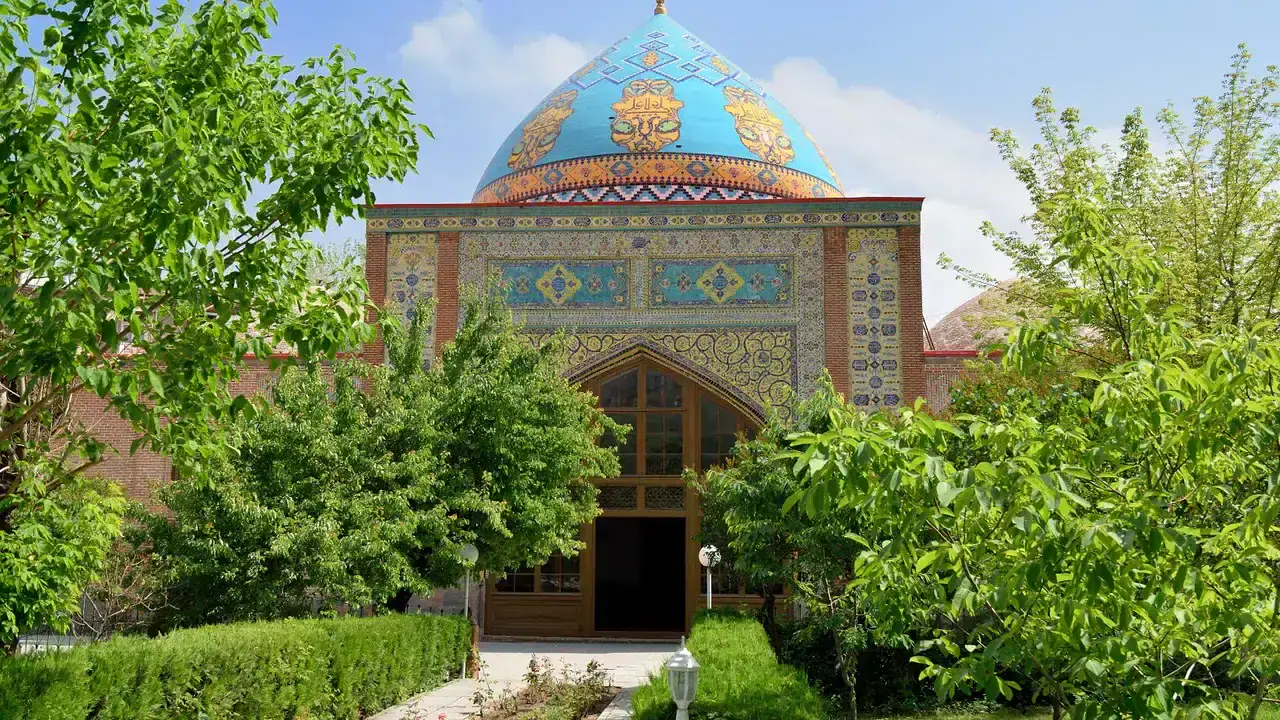
The Blue Mosque (also known as Gyoy Mosque or Huseyn Ali Khan Mosque) is an 18th-century Persian Shia mosque and the only functioning mosque in Armenia, built in 1766 (1179 AH) by order of Hussein Ali Khan, the Sardar (governor) of Yerevan under Persian rule, on the former site of the Def Sultan Mosque, which was destroyed in a 1679 earthquake. Once the largest of Yerevan's roughly ten mosques, it survived Soviet-era demolitions and served as the Yerevan History and Natural History Museum from 1937 to 1982 before being returned to religious use and restored with Iranian government funding in 1994–1998; today it is administered by the Embassy of Iran under a 99-year agreement signed in 2015. Visitors can see the rectangular complex (97.2 x 66.5 m) built around an inner courtyard (71 x 47 m) paved with tuff and centered on a stone fountain, the tall circular minaret (20 m) in the southwestern corner, prayer halls in the northern and southern wings, and the domes and minaret decorated with glazed blue, yellow, and green brick; the complex also houses a library, classrooms, and space for cultural events and exhibitions.
1 2 3 4 5 6 ... 10