Opera or ballet at the Opera House

Opera or ballet at the Opera House

Yerevan

The Armenian National Academic Theatre of Opera and Ballet, named after composer Alexander Spendiaryan, traces back to an opera studio founded in 1927 at the Yerevan State Conservatoire; the National Opera Theatre itself was established by government decree in 1932 and opened on January 20, 1933, with the premiere of Spendiaryan's opera "Almast." In 1935, Armen Tigranyan's "Anush" became the first opera staged on its dedicated stage. The theatre moved into its current building — designed by renowned Armenian architect Alexander Tamanian on Freedom Square — in 1940, and gained National Academic status in 1956. The complex houses two halls: the 1,200-seat Alexander Spendiaryan Opera and Ballet stage and the 1,400-seat Aram Khachaturian Concert Hall. What you can do there: attend an opera or ballet performance in the historic Tamanian-designed building, see the auditorium and grand staircase, and (outside show times) view the building and the surrounding Freedom Square/France Square area

Cultural
TUMO Center for Creative Technologies visit

TUMO Center for Creative Technologies visit

Yerevan

TUMO is a free educational center for 12–18-year-olds specializing in design and technology, with its flagship location in Yerevan at the edge of Tumanyan Park (the center's name is inspired by the park, named for writer Hovhannes Tumanyan). Founded in 2011 through the Simonian Educational Foundation (led by Sam and Sylva Simonian), the Yerevan center — designed by architect Bernard Khoury — also serves as TUMO's global headquarters and currently has around 15,000 active students. Students pursue self-directed learning, courses, and workshops across 14 creative-technology fields (animation, filmmaking, photography, programming, robotics, music, writing, and more) What you can do there: as a visitor (rather than an enrolled student), you can join a guided tour of the striking building and program to see the labs, workshops, and student work in action; tours are generally arranged for outside visitors/groups by advance request rather than a walk-in basis.

Cultural
St Gregory the Illuminator Cathedral visit

St Gregory the Illuminator Cathedral visit

Yerevan

The Saint Gregory the Illuminator Cathedral, also known as Yerevan Cathedral, is the largest cathedral of the Armenian Apostolic Church and one of the largest religious buildings in the South Caucasus. Built on the initiative of Catholicos Vazgen I, construction began on April 7, 1997, and the cathedral was consecrated on September 23, 2001, marking the 1700th anniversary of Armenia adopting Christianity as its state religion — the first nation in the world to do so, largely through the efforts of Saint Gregory the Illuminator. Designed by architect Stepan Kurkchyan and built of orange tufa from Ani, the complex comprises the main cathedral (seating 1,700), two smaller chapels dedicated to Saint Tiridates the King and Saint Ashkhen the Queen (150 seats each), and a belfry with more than 30 arches; the total complex is about 3,822 square meters, and the cathedral rises 54 meters to the top of its cross. It houses relics of Saint Gregory the Illuminator brought from Naples, and Pope John Paul II visited shortly after its consecration. What you can do there: visit the main cathedral and its two chapels, view the stained-glass windows and altar, see St. Gregory's reliquary in the narthex, and attend a service (major liturgies and church feasts are held here); candles may only be lit in a separate building on the southeast side.

Cultural
Vernissage Market

Vernissage Market

Yerevan

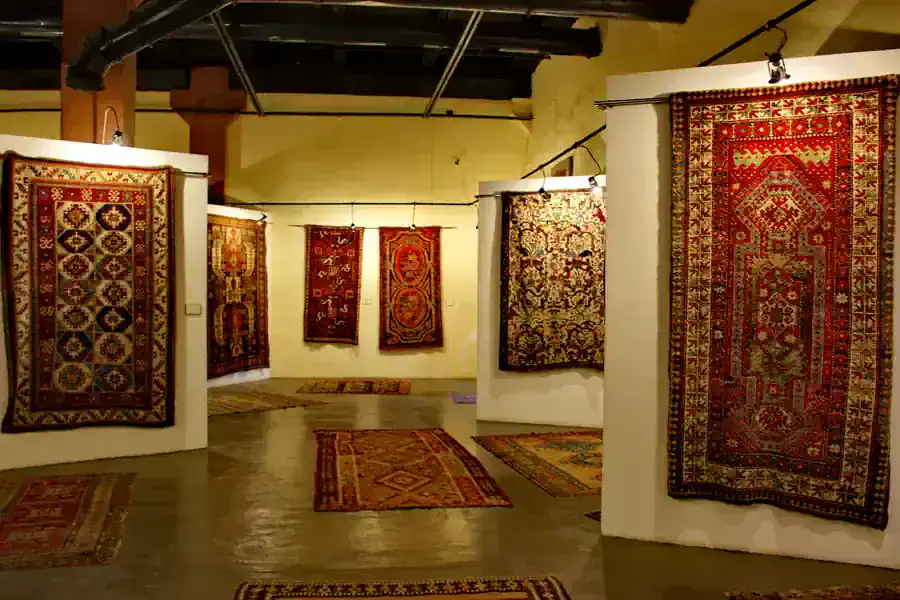
Vernissage is an open-air market-exhibition in central Yerevan, running along Hanrapetutyan Street from near the Republic Square metro station toward the Vardan Mamikonyan monument. It began in the 1980s as a spot where artists exhibited work near the Yerevan Opera House, and gradually grew as woodcarvers, jewelers, and sellers of antiques, carpets, and ceramics joined in; after the 1988 earthquake, it became an important source of income and a symbol of resilience for local craftspeople. Its name comes from the French "vernissage" (the preview of an art exhibition). It's busiest on weekends, when the largest number of artisans set up, but is open daily. What you can do there: browse and buy handmade Armenian crafts — ceramics, wood carving, small khachkars, lace and needlework, traditional dolls, paintings, jewelry (including Armenian-alphabet pendants and mythological symbols like the tree of life and pomegranate), carpets, backgammon/chess sets, folk clothing, books, and antiques (including old Soviet-era telephones, radios, and household items)

Cultural
Mother Armenia & Military Museum (Victory Park)

Mother Armenia & Military Museum (Victory Park)

Yerevan

The Mother Armenia Memorial stands atop Victory (Haghtanak) Park on a hill overlooking Yerevan. The pedestal was built in 1950 by architect Rafael Israelyan to commemorate the USSR's WWII victory and originally held a 17-meter copper statue of Stalin; that statue was removed in 1961, and in 1967 sculptor Ara Harutyunyan's 22-meter copper "Mother Armenia" statue was installed on the same base. The whole memorial complex, designed like a three-nave Armenian basilica and built of black tuff, stands 51 meters tall (22 m of statue, an 11-meter sword) and is modeled internally after the 7th-century St. Hripsime Church. Inside the pedestal is the "Mother Armenia" Museum of Military History, opened in 1970 (originally as the "Armenia in the Great Patriotic War" museum, renamed in 1995), with over 30,000 exhibits split between Armenia's role in WWII (including Marshal Hovhannes Baghramyan's personal belongings) and the Artsakh Liberation War. Around the monument are displayed Soviet-era military hardware — a T-34 tank, an armored personnel carrier, a MiG-19 aircraft, a Katyusha BM-13 rocket launcher, anti-aircraft guns, and an S-75 missile system — along with the Tomb of the Unknown Soldier and the "Heroes' Alley." What you can do there: view the Mother Armenia statue and climb to the open balconies for panoramic city views, walk through Victory Park, see the WWII/Artsakh War exhibits inside the museum, and examine the outdoor military vehicle and weapons display.

Cultural
Yerevan History Museum

Yerevan History Museum

Yerevan

The History Museum of Armenia is the country's principal historical and archaeological museum, located on Republic Square in central Yerevan. Its permanent exhibition traces Armenian history chronologically from the Stone Age through the Early, Middle, and Late Bronze Ages, the Early Iron Age, the Urartu (Van) Kingdom, Armenia under Hellenistic and Roman influence (6th c. BC–3rd c. AD), the Early through Developed Middle Ages, and the period "along the paths to the restoration of statehood" (15th–18th centuries). In 1935, the Government of Armenia divided the museum into several parts. The Museum of Art of the Armenian SSR was changed into the present-day National Gallery of Armenia and received 1,660 objects. The Museum of Literature has become the present-day Charents Museum of Literature and Art and received 301 objects and 1,298 manuscripts. The State Museum of Ethnography was founded in 1978 and received 1,428 objects and 584 photographs. You can view archaeological artifacts, ancient jewelry, ceramics, and medieval objects across the chronological galleries; join a guided tour in Armenian, Western Armenian, or a foreign language; take part in educational programs; buy from the museum shop. Price: Entrance ticket: 2,500 AMD (50% discount — 1,250 AMD — for RA pensioners, refugees, schoolchildren over 12, and students) Guided tour: 4,000 AMD (Armenian/Western Armenian) or 5,000 AMD (Russian, English, French, German, Arabic) Educational programs: 2,000 AMD Free for several groups (children under 12, ICOM members, museum staff, various state/disability/social categories) with valid ID/status document, and free for RA citizens on the last Saturday of each month

Cultural
Komitas Museum-Institute

Komitas Museum-Institute

Yerevan

The Komitas Museum-Institute is dedicated to Soghomon Soghomonian, known as Komitas — composer, choirmaster, folklorist, and founder of the Armenian national school of composition. It officially opened on January 29, 2015, following a 2013 proposal by then-President Serzh Sargsyan, and stands in Komitas Park on the site of the former Palace of Culture; the museum-institute building was designed by architect Arthur Meschian. The permanent exhibition spans eight thematic halls tracing Komitas's life and his work as a composer, musicologist, folk-song collector, and performer. The institute also runs a temporary exhibition hall (covering Komitas, his contemporaries, and related arts), a research center studying Armenian traditional and sacred music, a publishing house, a concert hall hosting traditional and classical music concerts, a music library with a large collection of musicological books and CDs, and educational programs including a summer school and the annual "Komitas" international conference-festival (held late September–early October). What you can do there: tour the eight permanent exhibition halls, view temporary art/music exhibitions, attend concerts, visit the music library, join educational programs (children/schoolchildren), and take a guided tour in Armenian, Russian, or English.

Cultural
National Museum-Institute of Architecture (Tamanian)

National Museum-Institute of Architecture (Tamanian)

Yerevan

The National Museum-Institute of Architecture after Alexander Tamanyan presents the history and development of Armenian architecture, with special attention to the architect who shaped modern Yerevan. Visitors can explore architectural drawings, historical photographs, building plans, scale models, personal archives and temporary exhibitions dedicated to Armenian architects and urban design. They can learn how Yerevan’s streets, squares and major buildings were planned, compare original concepts with the city as it looks today and discover the ideas behind some of Armenia’s best-known landmarks. The museum is especially worth visiting for architecture lovers, history enthusiasts and anyone who wants to understand Yerevan more deeply.

Cultural