Matenadaran manuscripts museum
Yerevan
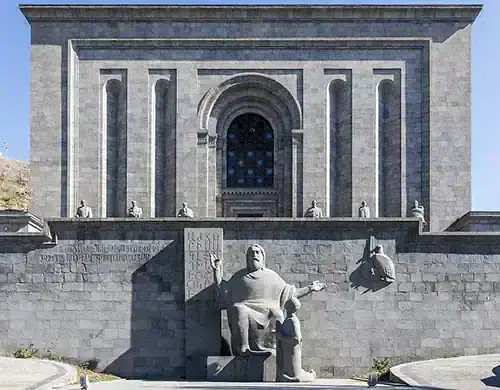
Matenadaran manuscripts museum
About
The Matenadaran, officially the Mesrop Mashtots Institute of Ancient Manuscripts, holds the largest collection of Armenian manuscripts in the world. Its roots trace to 1441, when the Armenian Church established a manuscript repository at Etchmiadzin following the Catholicosate's return from Cilicia. By 1913 that repository held about 4,660 manuscripts. The collection was moved to Moscow for safekeeping during the First World War and returned in 1922 with 1,730 additional manuscripts. The building was designed by architect Mark Grigorian, commissioned in 1939 and completed between 1945 and 1958. It stands 22.4 meters tall, faced in gray basalt, with a facade inspired by the 12th-century Church of the Holy Apostles in Ani. A five-story extension designed by Arthur Meschian opened in 2011, tripling the original space and adding modern preservation facilities. Today the Matenadaran holds around 23,000 manuscripts and scrolls, plus over 500,000 additional documents including decrees and periodicals. Its subjects range across theology, history, mathematics, astronomy, medicine, and philosophy. Notable items include the Lazarian Gospel of 887, the Echmiadzin Gospel of 989, and illuminated manuscripts by Toros Roslin.
What you can do: View illuminated medieval Armenian manuscripts, including works by the master miniaturist Toros Roslin. See the Lazarian Gospel (887) and the Echmiadzin Gospel (989). Learn about the Vehamor Gospel, the manuscript Armenian presidents are sworn in on. Explore exhibits on Armenian science, medicine, and philosophy as recorded in centuries-old manuscripts. Take a guided tour in Armenian or a foreign language.