Armenian Genocide Museum (Tsitsernakaberd)
Yerevan
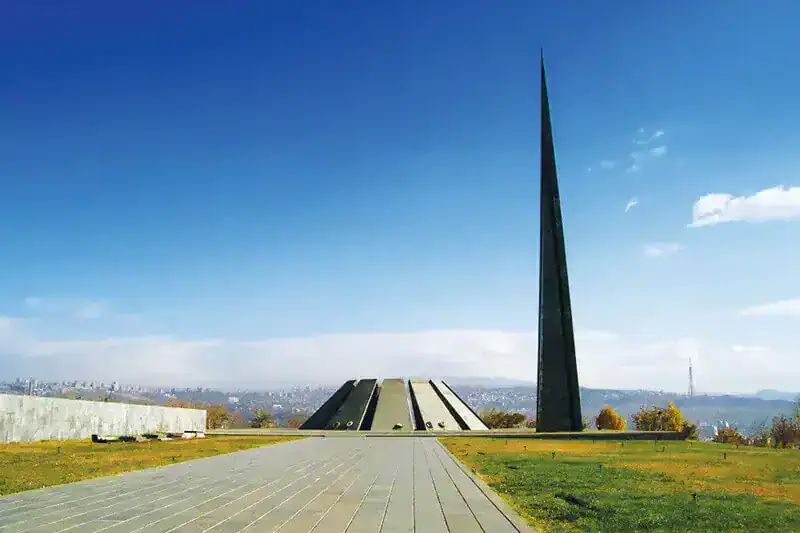
Armenian Genocide Museum (Tsitsernakaberd)
About
The Tsitsernakaberd memorial complex sits on a hill in Yerevan and serves as Armenia's official memorial to the victims of the Armenian Genocide. The idea for a permanent memorial dates to 1960 under the Communist Party leadership, and on February 15, 1965, Armenian authorities approved formal plans to honor the 1.5 million victims. It was designed by architects Arthur Tarkhanyan and Sashur Kalashyan with artist Hovhannes Khachatryan. The complex has three main elements. The Temple of Eternity consists of twelve basalt slabs arranged in a circle around an eternal flame, with the twelve slabs representing the historical provinces of Western Armenia. The Memorial Column rises 44 meters and is split into two sections symbolizing national rebirth. The Memorial Wall runs 100 meters and is inscribed with the names of towns and villages affected by the massacres and deportations, with the names of individuals who helped rescue Armenians during the genocide inscribed on its rear side. The Armenian Genocide Museum-Institute opened alongside the memorial in 1995, on the 80th anniversary of the genocide, designed by Sashur Kalashian, Lyudmila Mkrtchyan, and sculptor F. Araqelyan as a two-story structure built into the hillside so as not to compete visually with the monument above. It holds more than 1,000 square meters of exhibition space across three indoor halls and an outdoor gallery, along with a 170-seat auditorium, a library, and archival storage, and it conducts academic research and publishes the International Journal of Armenian Genocide Studies.
What you can do: Walk the memorial complex and see the Temple of Eternity, the eternal flame, the 44-meter Memorial Column, and the 100-meter Memorial Wall inscribed with the names of affected towns and villages. Tour the underground museum's exhibition halls documenting the genocide with photographs, documents, and testimony.